Saturday, July 09, 2011

164. Missional Liturgy: a prayer of dedication for our new neighborhood

We went prayer walking today with the apostolic band of folks who are moving into the new neighborhood with us. Before we started the prayer walk, my wife Tiffany (who is a prophet-shepherd according to APEST from Ephesians 4) read off a prayer that she crafted as a result of her reflections on the portion of scripture in the Chronicles where Solomon dedicates the Temple.

As she read it, I couldn't help but think about how this is the kind of thing that traditional liturgies aim to create, but ultimately fall short in because they are detached from mission and active engagement with what God is up to in the present. If a prayer, crafted out of deep reflection on God's nature and what he has been doing at the edge, away from the center of our organizations is what liturgy is all about, sign me up.

This is the prayer she read:


Neighborhood Prayer of Dedication

God, our Father in heaven, how awesome You are
So big and beautiful and bright.
Your love reaches into the deepest parts of us and fills us.
Oh Father, let us be a reflection of Your glory.
We give ourselves and this neighborhood to You
That Your will may be done
And that Your kingdom may come.
Let Your mighty power and love take us over.
Father, be the light to our path
Be our strength in weakness
Go before us in battle.

We give this neighborhood to You
We give this mission to You
Take it and have Your way.

Monday, July 04, 2011

163. The Atonement and Evangelism

 Me and my wife, along with another couple are moving into a new neighborhood across town to plant the gospel in that area. This is a move from the edge of town back to the center of town for us. Needless to say, there is a different culture, socio-economic people group with their own rhythm of life.

Moving into another cultural environment has reminded me once again that speaking about the gospel in meaningful ways requires two things. First, I need to be familiar with the multiple images and metaphors of the atonement. Typically, in the evangelical setting, we have majored on the penal substitution model of atonement, to the neglect of the other images and motifs contained within scripture. i.e Christus Victor, Recapitulation, etc. Second, I need to be familiar with the ways this particular culture experiences sin and the fall in both personal and systemic ways. Anytime you try to do cross-cultural evangelism (apostolic ministry to a degree), you should immediately ask yourself this question: What image or metaphor of the atonement will resonate most effectively with this person or people group? This may sound like splitting hairs, but it is worth a second look.

This article by Mark Baker illustrates how the image of the penal substitution model has co-opted the other images and supplanted the foundational narrative narrative, making itself the only image through which the other images are interpreted.

I will briefly quote it here:

"A number of factors may contribute to an articulation of the gospel that hinders understanding or connection. One contributing factor is viewing the penal substitution model of atonement as being the one and only explanation of how the cross provides salvation. In the New Testament, legal language of justification is one of a number of images used to proclaim the saving significance of Jesus‘ life, death and resurrection. Yet this one image has, in the form of penal substitution theory, become for many the foundational narrative of how the cross saves. When someone only has this one tool in their gospel toolbox it leads to situations like those we have just observed.

New Testament writers use a variety of images and motifs to proclaim the saving significance of the cross and resurrection, including: redemption, reconciliation, victory/triumph, justification, sacrifice, and ransom. They use different images for differing pastoral situations and for different audiences or contexts. Also, however, they use a diversity of images because no one image can capture the full meaning of the cross.


A foundational story is broader and deeper than an image. The various images, represented by arrows in the diagram, build off of, or find a place within the foundational story of how the cross and resurrection provide salvation. In essence, however, the penal substitution theory has taken
one image and sought to make it the foundational story. It is like taking one of the arrows from
the diagram above and turning it sideways as if it was foundational as in the diagram below.


It will not have the breadth to provide space for all the images. Although there will be room for
the sideways arrow to support a few other images, they will end up communicating something
very similar to the image used as foundation. One image does not have the depth of a true
foundational narrative to support diverse imagery. No foundational narrative of atonement can
fully capture the depth of the cross, but, in terms of the toolbox metaphor, we should work to
have a foundation, or toolbox, that will provide us with a rich variety of images, or tools, we can
use in evangelism."

I think Mark Baker is spot on here. He is not saying to get rid of the penal substitution model, he is merely trying to locate it within its proper environment, among other images, metaphors and motifs of scripture. This is something I will be keeping in mind as we begin to listen for the next six months on what aspects of sin and the fall are most clearly pressing in on this neighborhood and the peoples lives in it.

If the problem always defines the solution, then becoming intimately familiar with how sin is finding expression in a particular person or culture is a good indicator as to what model of the atonement will most easily connect with their experience. It is not to say you wont reference or utilize the other models of the atonement at some point in the process. Everyone stands to be enriched by a full exposure to the ways in which the gospel saves, and atones. The question is, which one will you lead in with??? Part of doing apostolic ministry is seeding the gospel into different cultures and people groups. In order to do this effectively, you have to be like Paul in Athens and let their culture provide the initial entry point and starting place to speak about the "unknown God."


Friday, July 01, 2011

162. MBTI and Organizational Cultures Part 4

Continuing this discussion on MBTI, I would like to make some application to our current community here. One of the books I have run across, that has been extremely helpful in diagnosing the MBTI personality traits of our church has been Companies are People Too (CAP2).

This book basically gives you a brief questionnaire to help you diagnose the "personality type" of your organization and then goes through that types strengths and weaknesses/areas to grow.

From what I can discern, Ikon is an ISFP as a whole. This does not mean we have all ISFP's in our community, it just means that our community, as a whole, tends to look inward and be communal, it notices and focuses on our immediate environment, makes our decisions based on how it will effect other people in the community, and has a certain allergic reaction to structure and organization. Essentially, we are organized chaos, with an emphasis on chaos.

The book has various companies in the biz world that they use as examples to say, your organization functions a lot like, say, IBM, or a community center, or accounting firm etc. Oddly enough, they say in all their research they have not found one single company that aligned or tested out as an ISFP!!!! They actually say in the book "You should be excited, and worried that you are so unique."

I immediately started to wonder what was up with our community!!!! Well, here's whats up. We are unique, and we should celebrate our strengths. However, we do need to own up to the challenges that come along with being an ISFP. For one, as an Introverted organization, we tend to struggle to focus our energies and attention outside of the community on a consistent basis. As most introverts will say, its not hat I don't like people, I just need some time to myself to refuel and recharge.

The Sensing factor means we pay attention to detail and notice our immediate environment. This can translate into efficiency in the here and now, but it does not take into account the big picture. We need the Intuitive factor to generate vision for the future.

The Feeling function means we make decisions based on our values and how it will effect other people. This ensures a pastoral, even prophetic (which is the majority of primary and secondary giftings in our community) impulse is strong in our community, but it also means that we veer away from pressing forward with tough decisions, especially when those decisions make others feel uncomfortable. The Feeling function needs the Thinking function to ensure holistic decisions are being made. 

The perceiving function allows us to be comfortable with chaotic environments, a lack of planning and structure. This can be a real asset when it comes to being adaptive to changing environments, but it poses quite a challenge when it comes to making progress and reaching the finish line on on things we start or "perceive" that need to be addressed. Perceivers' can be highly creative, but easily distracted. Basically, they like things to remain open ended. We need the Judging function to help us craft a plan and bring it to completion. This, if I am honest, has been one of the things that has been the biggest challenges for us as a community. We basically need to open up a can of "J" in our community and bring higher levels of organization to what we are doing.

A word of caution is due here about MBTI and personality types for organizations. Just like on the individual level, MBTI is not determinative. It only reveals preferences. It does not mean a "Feeler" can't function as a "Thinker." Likewise,  a "Perceiver" can operate in a "Judging" manner, they just wont be as efficient or find as much satisfaction in doing it. This non-determinative nature of MBTI is amplified when you go to the organizational level. If the character of an organization happens to be ISFP, they are not doomed to have an ISFP culture. They can activate and design their organization in ways that point them to their auxiliary functions, which means an ISFP can develop practices and habits that live more fully into their extroverted potentials. We are not asking people in the organization to be something they are not, we are just asking them to get out of their comfort zones and engage in things that stretch them and push them to mature into the undeveloped areas of their personalities and preferences.

If you are involved in leading a community whose organizational personality is prone to be more pastoral and prophetic, and not externally focused on evangelism and mission, then you basically find yourself in the role of what I have previously discussed as a Bricoleur.


Monday, June 20, 2011

161. MBTI and Organizational Cultures part 3

So I stumbled across something in my Evernote files that I saved a while back called "Competing Values Framework" which was developed by Cameron and Quin This is what it looks like:


 The basic gist of the CVF is that the different kinds of leaders in an organization will bring competing values to the table. Their personalities lead them to value different ways of relating to people and going about accomplishing the core tasks of the organization. This creates a certain kind of organizational culture. It could look something like this:


 If you haven't noticed, this looks very similar to four of the categories in the MBTI.

External Focus = Extroversion
Internal Focus = Introversion
Stability and Control = Judging
Flexibility = Perceiving

If we were to overlap the MBTI personality preferences to the CVF, and narrow it down to the Rationals Temperament (NT) it would look something like this:


The Judging folks obviously know how to get things done in a systematic, focused way. The Perceiving folks are all over the place, but can still meet deadlines and move things along. It just typically drives the J's crazy. NTP's major in the process of imagination and innovation, it is the E and the I that determine how and where this process typically takes place and where those innovative and imaginative resources are channeled. The next post will postulate what it would look like to have the NF's in the middle of the matrix. So, how would you label the four quadrants differently?


160. MBTI and Organizational Cultures Part 2

I am continuing my binge on MBTI. I ran across this FREE ONLINE TEST to discover what kind of MBTI "personality type" your organization has. This has got to be the coolest thing when it comes to MBTI. Check out the test here.

Thursday, June 16, 2011

159. Seth Godin on Organization, Movement and Philosophy

This came as a part of Seth Godin's weekly email updates. I thought it was quite instructive.

Organization vs. movement vs. philosophy

An organization uses structure and resources and power to make things happen. Organizations hire people, issue policies, buy things, erect buildings, earn market share and get things done. Your company is probably an organization.
A movement has an emotional heart. A movement might use an organization, but it can replace systems and people if they disappear. Movements are more likely to cause widespread change, and they require leaders, not managers. The internet, it turns out, is a movement, and every time someone tries to own it, they fail.
A philosophy can survive things that might wipe out a movement and that would decimate an organization. A philosophy can skip a generation or two. It is often interpreted, and is more likely to break into autonomous groups, to morph and split and then reunite. Industrialism was a philosophy.
The trouble kicks in when you think you have one and you actually have the other.


Wednesday, June 15, 2011

158. MBTI and Organizational Cultures

It seems I have caught the plague on researching MBTI. I really can't stop thinking about it, especially in relation to leadership and organizational culture. I am ENTP, and the P is what often throws a kink in my desire to see things really gain traction for the long haul. I am easily distracted to pursue new opportunities. So much so, that I can tend to drop things I have intentionally started and forsake them for the next new thing. Add to this my preference for the intuitive, abstract, conceptual world of information, and I can often find myself running around with so many rabbit trails, I come right back where I started, all to realize that I dropped some things, sometimes really important things, along the way.

In researching this topic of MBTI, leadership and organizational culture, I came a cross a really cool slide show that drew content from a book called Leadership in High Performance Organizational Cultures by Stanley Truskie. Truskie uses an odd combination of iNtuitive and Sensing along with Thinking and Feeling to create a matrix describing the different kinds of cultures created by leaders with these different combination's.(usually Judging and Perceiving are in the mix)

If you look at slide numbers 13-25 of the slide show, you will see a variation of this diagram.


As an NT, I function best when I am motivating people to press into the kingdom of God and his mission for us. I can honestly say that the most miserable I have ever been has been when I tried to lead as a SF with a consensus style of leadership.

The point of this diagram is not to say that one style of leadership is better than the other, per se. But to recognize that each combination of MBTI sets creates a certain kind of organizational culture when it is allowed to set the tone and style of leadership in that organization. All of these styles have a place in the organization, but it is typically the NT's or the NF's who will shake things up and get things moving in a group of people. They operate out of a vision for the future and a unsettling posture towards the status quo.

The tricky part for me has been negotiating the P side of my personality type. I read today in the book "Gifts Differing" (which my buddy Daniel Thigpen loaned me) that a P with no J is like a boat with all sail and no rudder. It can become directionless and blown around by whatever catches it's interests.

The thing about MBTI, of course, is that it is not determinative, You can learn to explore and cultivate what they call the auxiliary elements of your personality: those parts of you that you don't test positive on, but still manage to surface and come out when the circumstances are right. So I can function as a J, but I prefer a P approach to things. I enjoy the processing of things, rather than coming to closure. This means I enjoy the journey, not necessarily getting to the destination. In fact, if I never reach the destination, I can be fine with it, as long as I hop onto another journey. 

So a word of caution to all the P's out there, especially ENTP's. Don't let your personality type get the best of you. Every now and then you need to "open up a can of J" on what you are pioneering to make sure you reach the destination and your entrepreneurial ventures reach a level of sustainability.This is part of maturing and growing towards the fullness of Christ. (Ephesians 4:7-16).


Sunday, May 22, 2011

157. Lifeshapes and Cultural Upheaval

We are currently receiving some excellent training by the 3DM folks on discipleship and missional communities. This is a short introduction to the context in which the Lifeshapes are meant to function. I think the metaphor of a compass rather than a map is quite instructive.


Monday, May 09, 2011

156. Modality and Sodality

Ralph Winter first introduced the terms "Modality and Sodality" into the missiological world way back in the early 1970's. The basic gist of modality and sodality are the need for two different kinds of organizational structures within the church to accomplish the mission. A modality is an organizational structure that is designed for long term stability. It establishes routines and typically stays in one place for an extended period of time. The local church is typically organized as a modality.

A sodality is a group structure that is designed for mobility and trans-local activity. Their goal is not permanent residency, but seasonal, itinerant residency, that is marked with transition and travel.

In a recent conversation with Sam Metcalf, I was given a valuable piece of advice. If you are apostolic, then you will most likely be functioning with a more sodal-ic heart. As such, when you arrive in a particular location and look to establish a new modality, it should be stated from the get-go that you will not have a permanent residence within the community. This will not only help the group understand what is going on when you and a few others decide to "leave" the new group and pioneer another modality, it will also help establish expectations about leadership within the community. It can also serve as a good accountability device for those apostolic type people who, because of their trans-local, entrepreneurial nature, do not need to cement themselves into the organizational structure and leadership of the new community.  In order to function as a sodality, you can not remain as an integral part of the modality.

I can attest to this wisdom as the original "founding group" of people who first started Ikon are now looking to move out from the existing house churches they are in and regroup to start-up another missional community within our city. This move by the original group has created some tension within our larger community that otherwise could have been avoided if the original folks involved in the church plant understood themselves, and communicated to the new community, that thwere are two different kinds of church structures. One is more local and has a more stable design for longevity, the other is more mobile and is designed for itinerant, pioneering forms of work. It does not mean the modality can not be missional, it just means that the local church will look different, organizationally, then say, an apostolic band of people who are looking to start new communities and then move on. The nature of the task requires a different kind of organization for each. The key is: both are legitimate expressions and forms of ekklesia......church.

We need to recover this bi-focal vision of the ekklesia because there is no way we can accomplish our missional mandate without these two kinds of structures. The local, more modalic structures are too clunky and not flexible enough to do trans-local mission. The sodalic, more itinerant structures can not provide the same level of stability and continuity that the modalities provide. The truth is, we need both, and both of them need each other to be a truly missional movement.

In some ways, our church could not have predicted that things would have unfolded the way they have in the past year. None of the original group could have imagined that we would start over again, on the same team, with a new church plant. In some sense we are like an apostolic band who is being called to another work together. However, it would have been great to have understood the differences between a modality and a sodality from the beginning so we could have built those two concepts into our understanding of how we will organize for mission.

So, the great thing about laying new foundations is that you can start fresh! We will definitely build this understanding of the church into the new foundations we lay this second time around.


Monday, May 02, 2011

155. MBTI and Ministry Part 2

In the last post I pointed out my MBTI categories. I am particularly interested in how the categories of "J" and "P" play themselves out in apostolic people. We should first start out by recognizing that there are, according to Galatians 2, at leats two functions of apostolic ministry: Petrine and Pauline.

1.) The focus of Petrine apostolic ministry is more to the people of God, which entails engaging organizational and institutional contexts with a higher degree of regularity (and efficiency) than the Pauline. Petrine apostles find it more appealing to work with people who already have a good stock of religious capital.

2.) The focus of Pauline apostolic ministry is more to the "Gentile," or in other words, those who do not have much religious capital. Pauline apostles have an affinity for the wide open spaces of unsettled territory, more regularly AWAY from the center of the organization.

If we allow for this distinction, then the categories of "J" and "P" from MBTI may be helpful in deciphering ones orientation towards a Pauline or Petrine model of apostleship. 

The Role of "J' in apostolic ministry

If you are apostolic and happen to be a "J" on the MBTI, then this might be an indicator that you are more of a Petrine apostle than a Pauline.The J's love order, planning and structure. They plan their work and work their plan. They will be highly focused and driven to execute the strategy, ideally with little deviation till the plan has been accomplished. As such, they either tend to keep their attention focused straight ahead on the goal, or keep their heads down to ensure the plan is being executed. As a result, they sometimes steamroll right past people. They typically only see the end goal, not the people around them. If they do see people, it is as a means to an end. They are resources that help the "J" to get from point A to point B. The slide show on the previous post uses this diagram to illustrate the streamlined way in which J's approach tasks and deadlines.


This kind of approach makes Petrine apostles highly valuable to the organization. They are excellent at mobilizing people towards a specific goal and making sure the organization stays on track. Because they crave order and succinct game plans, they are most effective when they are in an environment that accommodates this disposition. The center of the organization, or a mobile organization, provides this environment for apostolic J's.

The role of P's in apostolic ministry


P's on the other hand, are another story.  They are perfectly at home in a more chaotic environment and minimal amounts of structure. They like to keep their options open and actually enjoy deviating from the plan. If you are apostolic and happen to be a P on the MBTI, you are most likely a Pauline type of apostle. You will crave the openness and possibilities of doing ministry where there are all kinds of contingencies, complexity and lack of organization. This does not mean that a P will not reach the deadline or that they will not achieve any sort of structure or bring order out of chaos. What it does mean is that they will take a different route to get there. Consider this diagram form the previous slide show.


While this kind of approach literally bugs the hell out of a "J", the "P" brings a certain advantage to projects that are being executed out and away from the more controlled environment of the organization. The "P" will more readily notice people and is often really good at noticing the person of peace. They have their eye on the developing patterns and opportunities around them. They are quite adaptive to changing circumstances. This is the kind of capacity one needs while working on the edge, away from the more predictable environment at the center of the organization. Apostles with a P are typically going to have a stronger gifting of evangelist mixed in somewhere in their APEST profile.

Finding the sweet spot between order and chaos is what both the J and P apostles bring to the table. they will both create what Dee Hock calls a chaordic environment. The only difference is, P's will more readily linger in the chaotic phase before they tighten the ropes and formulate some kind of order. The J's will bring a strong sense of order into the chaos a lot more quickly. There are advantages and disadvantages to both approaches, depending on the environment. Either way, P's need J's to standardize their ministries for sustainability, while J's need P's to recognize the opportunities floating all around them.

None of this, of course, is intended to box people up. I think an introverted person could also be a P and still function primarily as a Petrine apostle. The introverted dynamic being the decisive factor that points them towards a more Petrine function. The only point I am making is that if you crave order and structure, you may be more aligned with a Petrine function than a Pauline function. It is something worth thinking about. If I am right, then the line between Pauline and Petrine is negotiated between the combination's of E and I, and P and J, with N being a constant throughout.


Monday, April 25, 2011

154. MBTI and Ministry

Following up on the MBTI discussion, I thought I would reveal what I am according to MBTI. Actually, I have tested out different several times on the last four letters. Sometimes I test out as T, sometimes as an F. Sometimes I test out as P, sometimes as a J. I am told you sometimes test out differently based on the position you are in within an organization. Your responsibilities and the choices you have been making create a pattern and point of reference for how you answer the questions on the MBTI test.

So, right now, I am an ENTP, which means my tag line is "Life's Entrepreneur." We are also labeled as "inventors" in the book Please Understand Me II. I recently came across this picture on the Internet as I was searching for material on MBTI and my own personality type.


As an "inventor", we like creating proto-types and get off into weird and eccentric ideas. But we are not just idea people. We are bricoleurs and entrepreneurs. Which means an idea has to be tested and put into practice. We like to tinker, and play around with stuff. We are quite inquisitive and love a good problem to solve. We want to know if the idea will work or not, and we take great satisfaction when it does work. The obverse is true as well. We take great pains and experience deep angst when it turns out wrong or we experience failure. But typically, it is only for a short period. The next idea is just around the corner and we cant wait to explore it and innovate our way into another reality.


If you are an ENTP, you can pretty much locate yourself within the pioneer categories of the APEST ministries mentioned in Ephesians 4 (Apostle, Prophet, Evangelist, Shepherd, Teacher). The continuum looks something like this.


The pioneering modes of ministry mean you have an affinity for the edge, the frontier. You are looking to start or empower new things. Me myself, I am apostolic, so this explains my need to engage in entrepreneurial forms of ministry. In the next post, I will talk about how P's operate in leadership and how this shows up in the Pauline forms of apostolic ministry, making a few conjectures about the J's in contrast to P's when it comes to apostolic ministry.


Sunday, April 24, 2011

153. Understanding Team Dynamics using MBTI

I have been getting back into MBTI lately. I was really into it about 10 years ago, but drifted away from it. The 3DM crew integrate MBTI into their discipleship and leadership strategies, so hanging out with them has put it back on the radar for me. Check out this SlideShare Presentation:
Understanding Team Dynamics using MBTI

This is perhaps the most comprehensive, yet concise depiction of MBTI I have seen to date. The best part is towards the back where they make suggestions for teams and how to work with other teams and people who reflect a different orientation than yours. This is especially helpful when it comes to planting the gospel in team environments where most likely, people will be operating from different MBTI profiles.

Tuesday, April 19, 2011

152. Neighborhood Ministry

I recently came across this great article entitled The Good Guide to Better Neighborhoods: A Neighborhood Manifesto. The gist of the article is about how we need to reclaim our neighborhoods as a place where community can happen.

This article is particularly relevant to us as we are looking to move into another neighborhood across town with another family and somehow be a blessing to the people and organizations that live there. Some of the ideas in the article are great!.There are several links at the bottom of the articles that lead to entire articles on that one single idea. Short post for me, but great article(s) for anyone wanting to facilitate community in their neighborhoods.


Monday, April 18, 2011

151. Jay Lorenzen and The Language of Movement Building

I ran across this blog post on Jay Lorenzen's blog site and wanted to post in full here. His blog is entitled On Movements and is found here.

The Language of Movement Building: Think Pink!

by Jay Lorenzen on February 22, 2011
We spend several sessions discussing the “language of leadership” at our Gettysburg “If Properly Led” Conferences, arguing that the leader has a “palette” of words by which he paints visions in people’s minds. Our primary examples were Abraham Lincoln arguing for “new birth of freedom” at Gettysburg in 1863 and Martin Luther King, Jr arguing for “that dream of freedom was still unrealized” 100 years later. ”
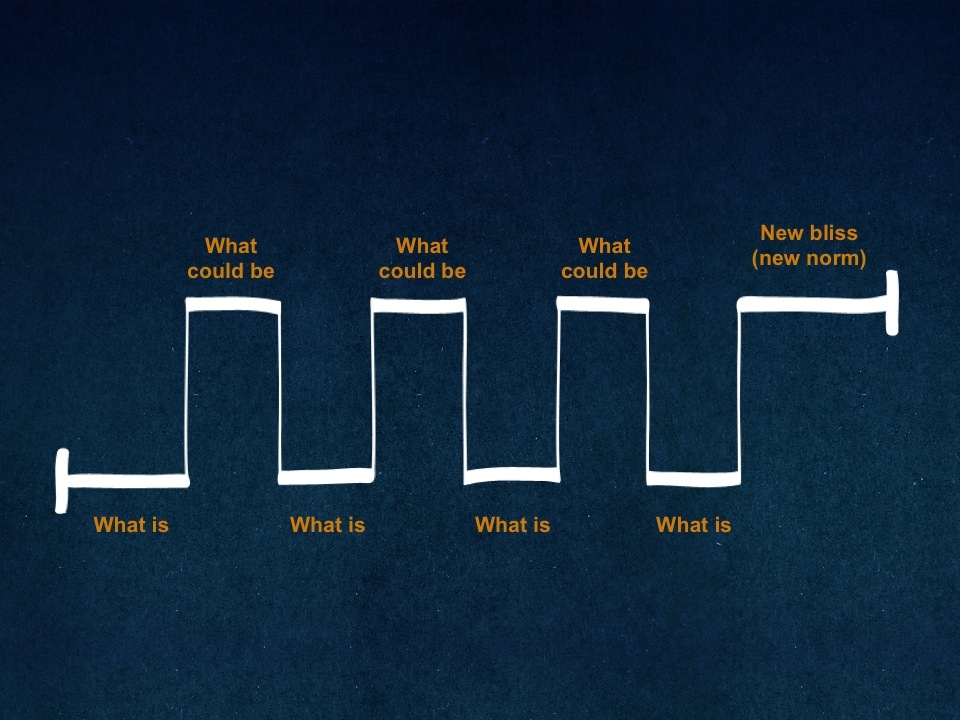
Nancy Duartel, on her blog, analyzed MLK Jr’s “I have a dream” speech and found that the speech was “not only literarily brilliant, but its structure follows a presentation form perfectly.” A presentation form (as in the diagram below) traverses back and forth between what is and what could be, ending in MLK’s speech with an description of the new bliss of equality.


In a previous post, I commented on Lincoln’s similar eschatological flow:

Lincoln’s leadership (as well as his speeches) seemed structured by an historical/existential/eschatological flow. In other words, he led from a sense of “what was right and wrong” about the past, from “what could be true in the future” while retaining an unrelenting commitment to “act in the present.”

Perhaps as we cast vision for movements everywhere, we need to adopt a similar form. We cast an “above the line” vision by traversing back and forth between “what is” and “what could be.” If you look at the speeches of leaders who have brought real change thru their words, you’ll almost always see this tension of “what is” and “what could be.”
For example, here’s what I trying out.
Today there are over 1600 community colleges where 60% of all colleges students in the US begin their college education. Right now, there are very few “transformational” movements on these 2 year campuses. The rapid turnover of students is most often blamed. What if, however, we tapped into the natural leadership potential and student orientation of the faculty teaching at these schools? What would happen if we found and encouraged faculty at these CCs to become missional team leaders? It’s happening already. Take a look at facebook.com/cru@communitycolleges.

Nancy Duarte, also analyzed MLK Jr’s “I have a dream” speech in terms of rhetorical devices, coloring each block of text between the crests and peaks of “what is and what could be.” She color-coded the blocks of text to highlight these rhetorical devices: blue stands for repetition; pink for metaphors; orange for political references and green for familiar literature and songs, from Scripture to “America”


You can see that there’s lots of blue and green here, especially at the end as he is riffing on “America.” But what’s really fascinating is how much pink you’ve got everywhere. We know that MLK was an expert at using words as a paintbrush…but seeing this speech in graphic form, you can see how often he resorted to “visual language” to hammer home his point. Leaders, in other words, when they speak, they “think pink” — metaphorically speaking.
As we discussed at Gettysburg, Aristotle once reminded us: “the greatest thing of all is to be master of metaphor.”
Think pink.

Wednesday, April 13, 2011

150. Acts 1:8 and the Exponential Algorithm

I want to look at point number 2 now from the previous post. Jesus envisioned his movement in Acts 1:8 going from Jerusalem to Judea to Samaria...to the ends of the earth. Is it just me or is there a massive geographical and cultural leap between phase three (Samaria) and phase four (ends of the earth) ???

If we look at the first three phases of missional extension, they are in relatively close proximity to each other, both geographically and culturally. Jerusalem, Judea, and Samaria are all in the same region. Jesus then says it will go form this incremental extension from one locale to the next, to a full blown global movement....huh? 

How does this work, and why did Jesus skip the progressive phases that would come after Samaria. Or, more importantly, why did he map out the trajectory of the movement in such incremental, iterative terms for three phases, in relatively homogeneous places and cultures? Why the micro to micro, and the to ful blown macro? Why not micro, to meta, to macro, or some other idea. Why not Judea, Asia Minor, Rome, and The world? Jesus jumps from a three phase process that evolved all in the same regional and cultural proximity, to a full blown global phase. Quite a skip hop and a jump! Why was Jesus vision of missional extension so disproportionate?
 
The only way to explain this missional trajectory is to use the word exponential. Jesus was plotting the course of the movement out of an exponential algorithm, one that took into the account the concept of multiplication, not just addition. To go from local, to regional, to global is an exponential algorithm. To make that kind of jump from regional expansion to a global expansion requires an exponential kind of growth.


Just like his own movement that spent 3 1/2 years discipling and multiplying his life into other people, Jesus now envisions the extension of that movement taking a slow start, working its way into the various pockets of the surrounding region, then moving into other cultural groups (Samaria) and then, as a result of multiplication, it explodes into a full blown, exponential movement to the ends of the earth. The only way you can explain this trajectory of mission and expansion is to use the word exponential, which carries with it the idea of multiplication, nut just addition. Jesus was working off of an exponential algorithm of growth and expansion. It was at the very core of his vision for the church.


Here is a cool video about the exponential capacity of making disciples and multiplication.


149. The prophetic moment of missional expansion in the book of Acts

I have been studying the book of Acts lately and I keep coming back to Acts 1:8 where Jesus says "But you will receive power when the Holy Spirit comes on you; and you will be my witnesses in Jerusalem, and in all Judea and Samaria, and to the ends of the earth.” I keep thinking about this progression from Jerusalem to the ends of the earth. Several things stick out to me.

1. It was a four phase process. It worked itself out progressively, from the center to the edge.
2. The first three phases are in close proximity to each other, both geographically and culturally. Then it jumps to a global mission focus. Big jump!
3. The Holy Spirit is the one who generates and empowers the church to move from one phase to the next. 

It is interesting to look at the transition points in the book of Acts when it begins to go from one phase of the process to the next. I want to focus on number one, specifically the transition from Jerusalem to Judea and Samaria. 


The church stays in Jerusalem for 7 chapters of the book of Acts. Most people think it was persecution that caused them to leave. I would agree, but only partly. In chapters 4 and 5 they had already experienced persecution. So what was it that got them to breach the lines of Jerusalem and move out beyond the boundaries of the city? 

Well, it all points to Stephen on this one. Stephen presents a riveting interpretation of God's activity with most of Israel's heroes....and almost all of this activity happens outside the boundaries of the Holy Land. Even when they get to the Temple section of the their history, Stephen is quick to point out that God snuffed at the idea of being located in a Temple. The heaven is my throne, the earth is my footstool." Stephen is deconstructing what some today call Temple Theology. The longest sermon in the book of Acts is, ironically, not about the "gospel" per se, but about how God does his most important work away from, and is "located" outside of, the Holy Land and the Temple.  Stephen has taken on the establishment and literally the "holy cows" of his day. 

It is important to notice something about the nature of Stephens critique here though. Stephen does not negate the temple here. He is not delegitimizing the place of the temple in history. What Stephen is doing in his sermon is neutralizing the Temple by pointing to places and people that God did amazing work through outside the boundaries of the Temple. Negating and neutralizing are two different things. He is not saying "remove yourself from the Temple," but rather to "re-map the Temple in relation to God's history and present mission."

It is not until Acts 7 that anyone makes it out of Jerusalem with the gospel. It is interesting to note here, also, that the same word Luke uses in Luke 10:2 to say "send out" workers into the harvest field  is the same word Luke uses in Acts 7 to describe Stephen being thrust out/sent out of the city of Jerusalem. The word is ekballow, which has a violent, disruptive flavor to it. Stephen is the first to break the boundaries of the city in the Acts narrative, but only by violently being "sent out" by the authorities that he pisses off in his sermon. 

Stephen is obviously playing a prophetic role here in Acts 7 by calling out the gap in their theology and calling for a re-mapping of space in light of God's previous activity, and ultimately the ascension. It is not surprising Luke uses a disruptive/disequilibrium word here for "send out" then. Being dis-located is often a disruptive experience, no matter who you are, and it often requires some outside forces to create movement. (This is one reason why Jesus says the Holy Spirit will bring you power to move you across these boundaries.)

So what we have here is a prophet stimulating, provoking, and activating the missional forces of the church! Through Stephens prophetic ministry, the church is "ekballowed" out of the city into the harvest field...Judea and Samaria. Unfortunately like most prophets, they are marginalized by the establishment, "outside the city," and do not necessarily enact the thing that they envision. Oddly enough, it is at the death of this prophet that we are not only introduced to a new chapter in the churches missional journey, we are also introduced to an apostle who will help the church make the transition from Judea and Samaria to the utter most parts of the earth...the apostle Paul. once again, we see a connection between the prophetic and the apostolic, both in individuals, and in vocations. No wonder Paul says apostles and prophets are foundational ministries in the church, they are at the very forefront of the church breaking out of its closed systems and transitioning into new territories and phases of missional expansion.


Sunday, April 10, 2011

148. Missional Community Video for Ikon

Our network gathering was this past Sunday, a time when both of our house churches come together to worship, hang out, get all network-ey, and dabble in matters related to values and vision.

We presented this video to the larger community to introduce what is currently being labeled as The Cunningham Farms Missional Community (we will rename it with a more sexy title later). A group of at least 5 people will be living in this neighborhood and doing the incarnational ministry thing here. Basically, we are entering a second "church plant", but like some of the people on the team have said, we want it to be more than a "church" in the conventional sense of the term. We are starting a missional community, infused with a discipling culture, that will catalyze a movement of disciple making and missional communities, each with their own mission focus (neighborhood or network.)


Monday, April 04, 2011

147. Integrate then Innovate

There is a small group of people in our community right now who are looking to move out of their existing neighborhood and move into another neighborhood across town to take up residence and incarnate the gospel in that particular neighborhood.

We just got back from a retreat this weekend where we spent roughly two days scammin on how all of this should go down. It was a whiteboard, brain storm, strategizing session if you will, with some prayer and devotion mixed in through out. What we came away with was a 1 year plan  of how to proceed.

As we sat around and discussed what it would look lie for us to do incarnational ministry, we landed on a phrase which I think will become part of our discourse when it comes to neighborhood ministry. We basically said that incarnational ministry requires that you integrate before you innovate. In other words, you have to hang out with people, participate in the rhythms of that context, and get in touch with the needs of the community before you try to initiate programs, ministries or events to meet the needs of the neighborhood.

Choosing to immerse ourselves in the neighborhood before we start any new kind of ministry, do any kind of service project, or initiate any kind of programs will ensure that our innovations are on target and actually address a real need in that community.

Even more, it will allow us to respect the area, and avoid the stigma of outsiders coming in with their own plans to somehow "save" the neighborhood or the people who live in it. We want to listen to the people and the neighborhood before we develop intricate plans about how to impact the people and the neighborhood.

So how long should you integrate before you innovate? This is a good question. We asked this very thing. Our general impression, for our particular context, was to integrate for the first six months.  This would involve hanging out at the 3rd places, volunteering at local community center, riding the public bus that goes through that area etc. All the while, we will be intentionally observing and listening to the inner voice of the community.

At the end of 6 months, we are going to pull back as a team and share our observations, reflect on their meaning, and discuss what the implications are for entering into a phase of innovation where we look to initiate new ministries, events, or strategies to meet some tangible needs of the community. Approaching it this way will ensure the needs of the community set the agenda for how the process of innovation will take place, not our own premature assumptions about what needs to happen there.

I should say that this is not the only way to do innovative mission, but when moving into a neighborhood, it seems to us to be a good way to approach it.


Friday, March 25, 2011

146. A fitting poem to describe apostolic folks

I found this poem on Sam Metcalfs blog. (a great blog about the apostolic and missional issues.) Thought I would republish here. It is a nifty description of of the apostolic person and their experience in relation to institutional dynamics.

There’s a race of men that don’t fit in,
A race that can’t stay still;
So they break the hearts of kith and kin,
And they roam the world at will.
They range the field and they rove the flood,
And they climb the mountain’s crest;
Theirs is the curse of the gypsy blood,
And they don’t know how to rest. If they just went straight they might go far;
They are strong and brave and true;
But they’re always tired of the things that are,
And they want the strange and new.
They say: “Could I find my proper groove,
What a deep mark I would make!

Because apostolic people are intrinsically entrepreneurial, they often have a wanderlust of sorts. I have seen this very pattern in my own life, and in others. One of the people in scripture I relate to is Barnabas. As a Levite, he was tied to the Temple system, a system not so friendly to the entrepreneurial, pioneering types. It seems that Barnabas was an apostle in waiting. (Acts 14) and it took a genuine encounter with the gospel, and another apostle, Paul, to fully awaken this in him and legitimize it. Once this happened, it seemed that he was able to migrate away from the the institutional domain of the temple and venture out into the frontier.

I at one time was doing traditional ministry as a "pastor" and eventually discovered I was gifted apostolically. What a release! What an affirming experience to know you are not weird or a misfit. I was simply an apostle in a pastoral setting. Needless to say, it is not very conducive for a pioneer to be stuck at the settlement. It always makes me wonder how many apostolic folks out there think they some how do not fit in because they are stuck in a monolithic system that caters primarily to the settlers. Lets broaden the scope and recognize both pioneers and settlers. 

Tuesday, March 08, 2011

145. The Point of Leadership

This is a fabulous article by Tim Elmore on leadership. I am going to post it in full here. Enjoy!

Two Paradoxes Leaders Embrace
By Tim Elmore
Why do intelligent, emotionally healthy people need leaders? Wouldn’t you think that a group of fifteen people who are all reasonably smart could figure out the best direction to take without someone telling them?
On paper, this makes sense. It sounds great. It just doesn’t play out in life.
Think about leadership from a philosophical standpoint. People need leaders not because they are stupid. In fact, quite the opposite. It may be because all team members are brilliant that they need leaders. Historically, the primary need for leadership is to galvanize and steer. Leaders galvanize multiple minds and steer multiple gift sets into one, clear direction.
I remember being on a team several years ago. Everyone on the team was sharp; in fact, most of us had served in leadership roles in the past. We didn’t need a leader for information or inspiration. We all knew as much as our leader did. However, someone needed to step forward and furnish clarity. We needed one clear direction and we needed someone to determine how our talents best fit together. The team members didn’t lack ideas—our problem was we had too many of them. Our leader brought clarity and synthesis.
The first role a leader must embrace is to be the focal point for a season. This doesn’t mean that the cause is all about the leader. (It should never be about the leader.) It means this person must be alright being the point of focus at first to eradicate sideways energy. Someone has to help people say “no” to the many good things they could do, and “yes” to the one, best thing they could do. Even the most reserved, and quiet leaders must initially embrace this attention and prominence.
The journey doesn’t end there, however. If a person has led well, he or she arrives at a destination precisely opposite this initial role. Effective leaders eventually create momentum, then slip into the shadows. They stay out of the way of good talent and teamwork. To use a cliché, they work themselves out of a job. They eventually become unnecessary if they have done their job well. I think of Herb Brooks, the coach of the 1980 U.S. Olympic Hockey team. He had incredibly talented young players who desperately needed his strength and focus in the beginning. There was too much energy, and egos going too many directions. In the end, however, once the Americans had won the gold medal, he slipped into a hallway and sat on the floor. He said the moment was about the team, not him. In reality, it was about something even bigger than the team. That gold medal did something for the U.S. at the time. We defeated the invincible Soviet team. The cause was nationwide morale and hope. David had beaten Goliath. The cause should always be bigger than people.
So, leaders actually embrace two paradoxical ideas. First, they must be OK with being the prime focal point. Talent and intelligence need focus. In the end, they must embrace obscurity. They chuck their ego—and point everyone toward the bigger picture. This is a rare paradox—which makes it beautiful when it happens.
Tim